
(EN version below)
Nella Laguna: perché questo titolo?
Quando ho iniziato a dedicarmi alla creazione delle opere per LAGUNA, la mostra che avverrà il prossimo 29 agosto presso Villa Davoli a Reggio Emilia, non avevo ben chiaro che cosa avrei proposto. Come sempre seguo delle ondate di istinto che mi portano a non pormi troppe domande, ma solamente a seguire quello che “è già dentro di me e ha bisogno di essere tirato fuori”. Il titolo e la scelta dell’argomento non hanno nemmeno richiesto tempo per essere ricercati e quando mi hanno chiesto di creare la locandina per promuovere l’evento, le immagini, i colori e appunto l’argomento sono uscite fuori naturalmente in un batter d’occhio; come l’acqua che scorre e segue le ramificazioni più facili da raggiungere o semplicemente si lascia guidare dalla forza di gravità. E’ stato un puro atto di creatività che trova il proprio sfogo.
Se per la mostra è chiaro l’argomento: immagini, visuali e prospettive di Venezia, forse è meno chiaro lo stile artistico. Non è banale darsi una connotazione, un tipo di identità artistica che verrà riconosciuta e che porti a conquistarsi una identity. Forse non è nemmeno tanto necessario, non lo so, ma credo che in ogni processo di evoluzione artistica in molti siano arrivati a definire quello che per l’appunto viene chiamato “il proprio stile”. E penso da una parte che non si tratti nemmeno di una forzatura, perché per un artista “stile” equivale a “il proprio marchio di fabbrica”, ciò che ti fa riconoscere in mezzo a tanti, la particolarità che è necessaria per raffinare la propria arte in modo che sia apprezzata o forse solamente valutata appartenente a quella persona, a quella personalità e al modo di vedere le cose a lei connesso.
A cosa serve un’identità artistica?
Mi chiedo se ci sia reale necessità di connotarsi e credo fortemente che sia un processo che avvenga da sè. E’ vero che ciascun grande artista, che sia pittore, musicista, scrittore o chiunque sfoggi un esercizio d’arte, nel tempo, tende a prediligere una certa forma, un certo suono o un certo stile di scrittura, ma probabilmente questo avviene perché si esercita maggiormente in quello sfoggio artistico e quindi, come in tutte le cose, più le si ripete e più ci si migliora? Se ne scoprono i dettagli, si sbaglia, si ritenta e ci si riprova. E quindi alla fine si conosce la tecnica, o l’intomazione sonora o l’arte di mettere insieme le parole al meglio che ci sia. Non credete sia così?
Per quanto mi riguarda io so solamente che per me è imprescindibile esplorare ed esplorarmi come artista, non sono ancora in grado di “attaccarmi” a una tecnica. Forse non devo nemmeno. Ma so solamente che quando mostro le mie opere spesso i più rimangono stupiti e mi dicono: ” non sembrano nemmeno fatti dalla stessa persona!”, ad indicare quanto io diverga nelle tecniche che utilizzo. In particolare l’ultimo tentativo l’ho proprio fatto mostrando le opere che proporrò per LAGUNA ed è stato ancora più interessante poiché per lo meno l’argomento è uno solo e si caratterizza, come dicevo, per lo più da scorci di Venezia, in particolare la forma delle gondole e il movimento dell’acqua. Case e edifici sono più stilizzati e rimangono in sottofondo, anche se non in tutti i miei dipinti. Nonostante ciò sono riuscita, senza prefiggermelo, a dare forma a opere veramente molto diverse l’una dall’altra e questo perché seguo il flusso della mia ispirazione, che è influenzata dall’ambiente nel quale mi trovo, dalla mia emotività del momento, dal tempo e dalla stagione, per non aggiungere altri sentimenti che ovviamente fanno parte di tutto ciò che caratterizza l’essere umano e che ci rende diversi e unici nella nostra singolarità. Questo è il valore aggiunto di un’opera d’arte.
IA: intelligenza artificiale
Posso crearla anche con l‘intelligenza artificiale, ma non potrò mai ricreare la stessa profondità emotiva e il legame che può instaurarsi tra chi osserva, chi legge o chi ascolta un pezzo se non attraverso l’empatia umana e la vibrazione che si instaura inspiegabilmente tra artista e ammiratore, mentre mi sto lasciando coinvolgere da “quella cosa lì”. E’ qualcosa di intangibile e richiede innanzitutto capacità di coinvolgimento profondo e sono anche convinta che non debba cercare di essere spiegato, proprio perché non è dato esserlo, ma possa solamente essere trasmesso nelle modalità più diverse e che poco hanno a che fare con la razionalità. La tecnologia è un grandissimo strumento, ci, e mi permette di poter fare tantissime cose, ma allo stesso tempo è una medaglia a due facce e io temo gravemente che, quando parliamo di vibrazioni e di “sentire umano”, ci stiamo follemente perdendo, rincretinendo e assuefacendo. Siamo come anestetizzati, sembra quasi andare di moda non provare più niente perché il flusso di informazioni che ci arrivano è così alto, che non è nemmeno possibile, anche volendo, poterle elaborare tutte e quindi finiamo in uno stato di insensibilità, che di conseguenza ci porta ad ignorare e a non riuscire più a lasciarci coinvolgere emotivamente e profondamente.
La mia interpretazione
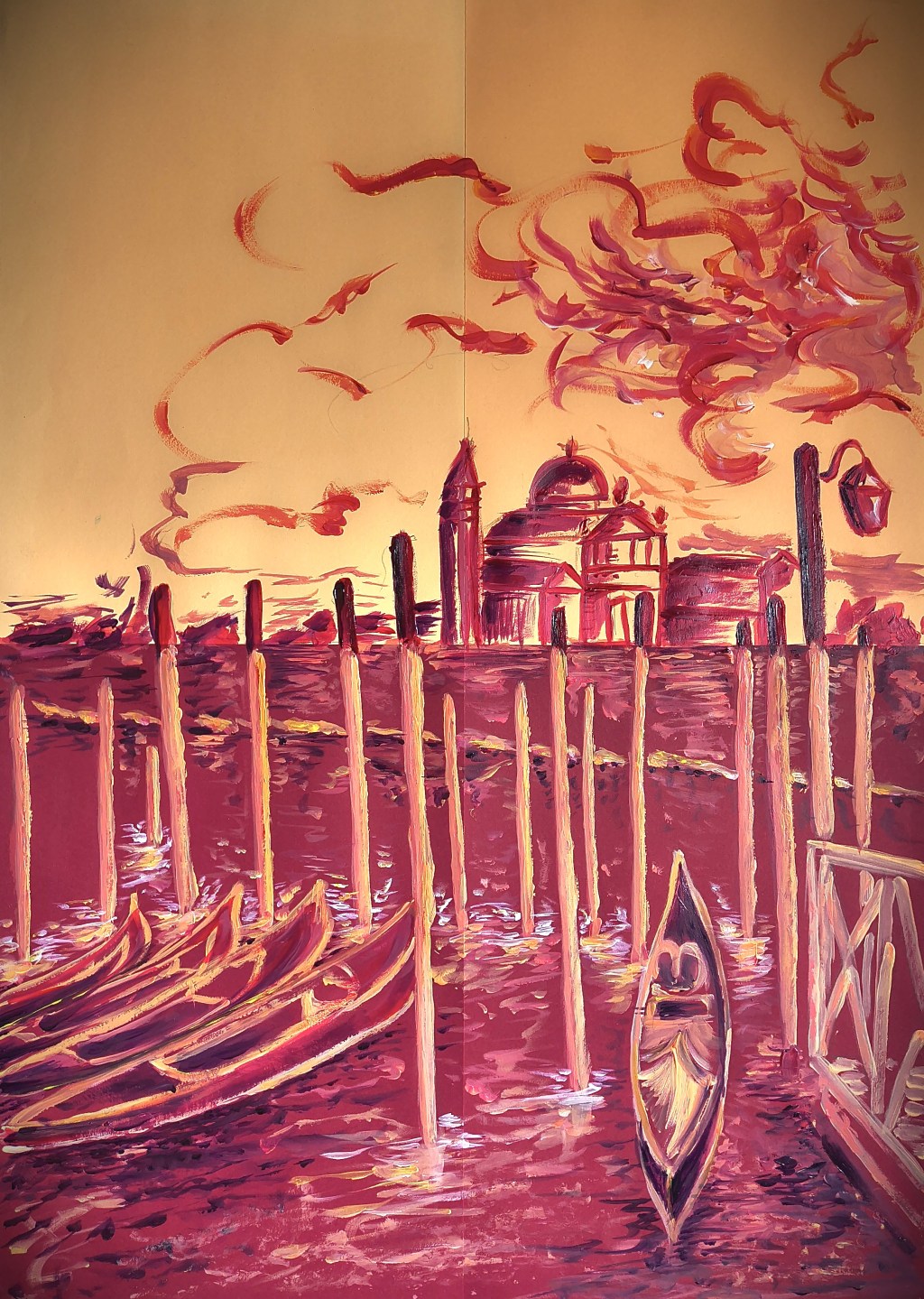
Quindi nella mia esplorazione artistica “Venezia on fire” è in realtà nato come progetto di accostamento e scontro cromatico, tra tinte chiare e scure pitturando su sfondi non bianchi, come classicamente viene fatto. Ne è uscito un risultato che nemmeno io mi aspettavo, di forte impatto e quasi anche di allarme per la fase di cambiamento climatico che stiamo vivendo. Per me l’idea originale era di rivisitare Venezia con altri occhi, come di osservarla attraverso altre tinte che si discostassero dalla mera realtà. Come artista volevo “disassociarmi” dal blu, dall’oltremare e dal cobalto (colori che tanto amo) per sposare una prospettiva cromatica nuova e finora inesplorata.
…e quella degli osservatori
Mi ha risuonato e anche stupito, ma allo stesso tempo entusiasmato osservare e ascoltare l’interpretazione che i vari osservatori ne davano. E ho denotato una visione comune: il rosso interpretato come fuoco, veleno, inquinamento, sfacelo. In generale il rosso è una tinta forte, impattante, è protagonista e dominante, ma non sempre connotabile in negativo; è anche il colore dell’amore, della passione, della forza e dell’audacia ad esempio. Mi ha intrigato denotare che la prima istintiva reazione fosse proprio legata a una voce di allarme e di pericolo. E voi che cosa ne pensate? Qual è la vostra reazione? Che cosa vi suscita Venezia on Fire?
Grazie per i vostri commenti, sarò felice di leggere le vostre impressioni e le reazioni suscitate dalla mia opera.
EN Version
In the Lagoon: why this title?
When I started dedicating myself to creating artworks for LAGUNA, the exhibition taking place on August 29 at Villa Davoli in Reggio Emilia, I wasn’t quite sure what I would propose. As always, I follow waves of instinct that lead me not to ask too many questions, but simply to follow what “is already within me and needs to be brought out.” The title and the choice of the topic didn’t even require time for research, and when I was asked to create the poster to promote the event, the images, colors, and indeed the topic emerged naturally in the blink of an eye; like water that flows and follows the easiest branches to reach or simply lets itself be guided by the force of gravity. It was a pure act of creativity finding its outlet.
If the topic of the exhibition is clear: images, visuals, and perspectives of Venice, perhaps the artistic style is less clear. It is not trivial to give oneself a connotation, a type of artistic identity that will be recognized and that leads to earning an identity. Perhaps it is not even that necessary, I don’t know, but I believe that in every artistic evolution process, many have come to define what is aptly called “one’s own style.” And I think, on one hand, that it’s not even a forced thing because for an artist “style” equates to “one’s own trademark,” what makes you recognizable among many, the uniqueness that is necessary to refine one’s art in a way that is appreciated or perhaps merely assessed as belonging to that person, to that personality, and to the way of seeing things connected to them.
What is the purpose of an artistic identity?
I wonder if there is a real need to define oneself, and I strongly believe that it is a process that happens on its own. It is true that every great artist, whether a painter, musician, writer, or anyone showcasing an art form, tends to favor a certain shape, sound, or writing style over time. However, this probably occurs because they practice that artistic expression more, and thus, like in everything, the more you repeat it, the better you become. You discover the details, make mistakes, retry, and give it another shot. In the end, you learn the technique, the tonal quality, or the art of putting words together in the best way possible. Don’t you think so?
As far as I’m concerned, I only know that for me it is essential to explore and explore myself as an artist; I am not yet able to “adhere” to a technique. Perhaps I don’t even need to. But I know that when I show my works, often the most surprised people tell me, “they don’t even look like they were made by the same person!” indicating how much I diverge in the techniques I use. In particular, my latest attempt was made by showcasing the works I will be presenting for LAGUNA, and it was even more interesting because at least the subject is one, characterized, as I said, mostly by glimpses of Venice, particularly the shape of the gondolas and the movement of the water. Houses and buildings are more stylized and remain in the background, although not in all my paintings. Nonetheless, I managed, without intending to, to create works that are truly very different from one another, and this is because I follow the flow of my inspiration, which is influenced by the environment I find myself in, my emotional state at the moment, the weather, and the season, not to mention other feelings that obviously are part of what characterizes being human and makes us different and unique in our individuality. This is the added value of a work of art.
AI: artificial intelligence
I can create it with artificial intelligence, but I can never recreate the same emotional depth and the bond that can be established between those who observe, read, or listen to a piece, except through human empathy and the inexplicable vibration that develops between the artist and the admirer while I am getting involved with “that thing.” It’s something intangible and requires, above all, the ability to deeply engage, and I also believe it should not try to be explained, precisely because it cannot be, but can only be transmitted in various ways that have little to do with rationality. Technology is a great tool, and it allows me to do so many things, but at the same time, it is a double-edged sword, and I seriously fear that when we talk about vibrations and “human feelings,” we are foolishly losing ourselves, becoming dull, and getting addicted. We are like anesthetized; it almost seems to be in fashion not to feel anything anymore because the flow of information we receive is so high that it is not even possible, even if we wanted to, to process it all, and thus we end up in a state of insensitivity, which consequently leads us to ignore and forget how to engage emotionally and deeply.
My Interpretation
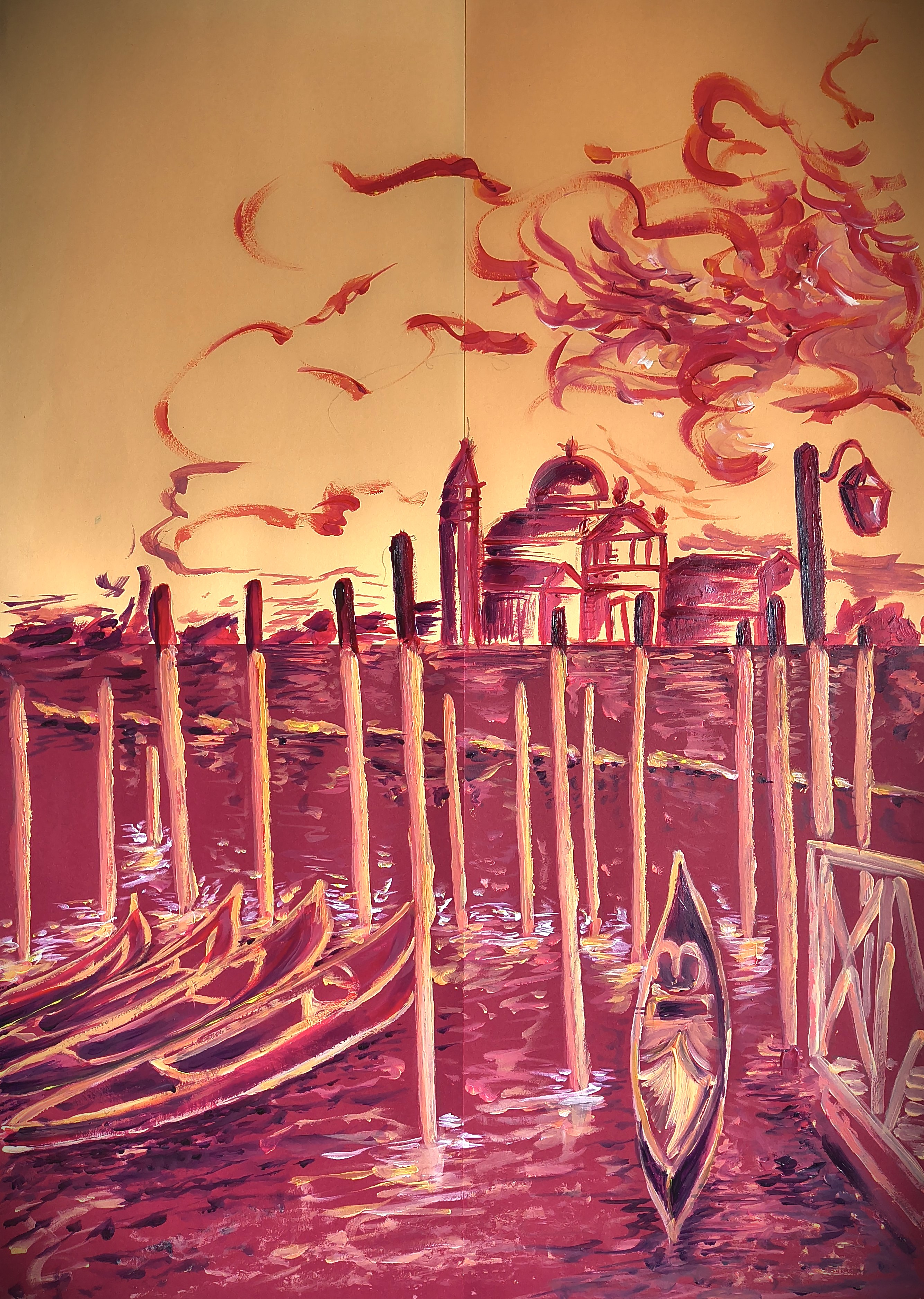
In my artistic exploration, “Venezia on fire” was actually born as a project of color juxtaposition and clash, between light and dark hues painted on non-white backgrounds, as is traditionally done. The result came out more impactful than I expected, almost alarming in light of the climate change phase we are experiencing. For me, the original idea was to revisit Venice with a different perspective, to observe it through different colors that deviated from mere reality. As an artist, I wanted to “disassociate” myself from blue, ultramarine, and cobalt (colors that I love so much) to embrace a new and yet unexplored chromatic perspective.
…and that of the observers
It resonated and even surprised me, but at the same time, I was thrilled to observe and listen to the interpretations that various observers gave. I noticed a common vision: red interpreted as fire, poison, pollution, decay. In general, red is a strong, impactful hue, it is a protagonist and dominant, but not always negatively connoted; it is also the color of love, passion, strength, and audacity, for example. I was intrigued to note that the first instinctive reaction was directly linked to a voice of alarm and danger. And what do you think? What is your reaction? What does Venezia on Fire evoke in you?
Thank you for your comments; I will be happy to read your impressions and the reactions evoked by my work.
 ReVivoArtistry
Leave a comment